Open SourceSubsForge — Subtítulos con IA, 100% en local
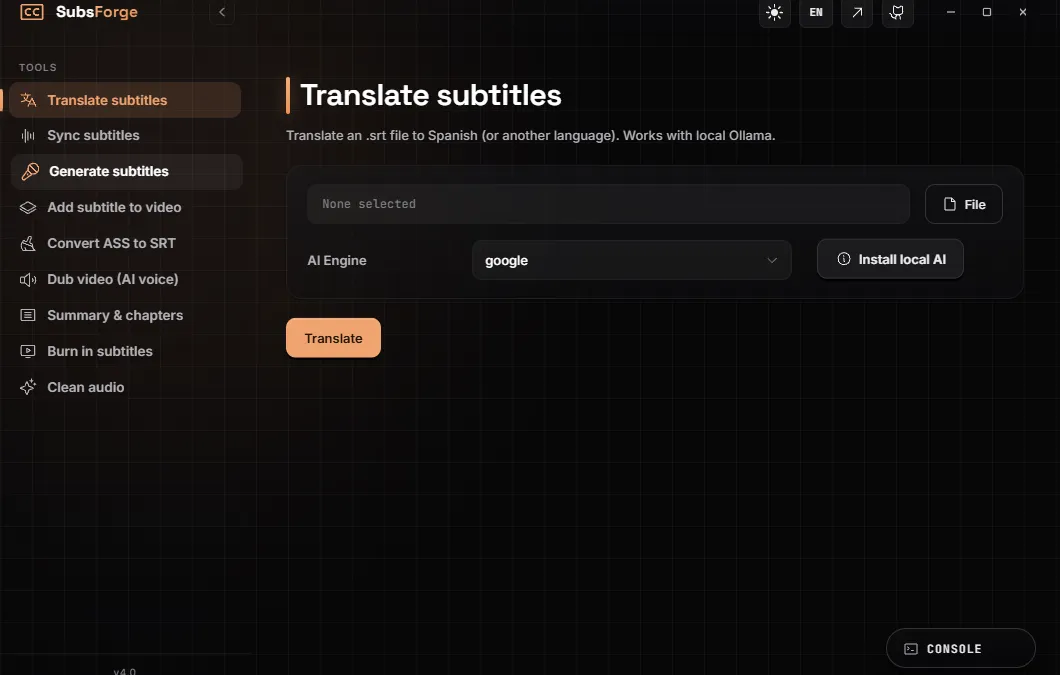
App de escritorio para traducir, generar, sincronizar, fusionar, limpiar, doblar, resumir e incrustar subtítulos de vídeo con IA — sin servicios de terceros y funcionando 100% en tu máquina. Nueve herramientas en una: traducción por lotes (nube u Ollama local), transcripción con Whisper, sincronización por detección de voz (VAD), doblaje con voces TTS, hardsub y limpieza de audio. Por dentro: Tauri 2 + Rust como puente y un sidecar de Python (faster-whisper, FFmpeg, ffsubsync, edge-tts) que hace el trabajo pesado sin bloquear nunca la interfaz.
Subtítulos IAWhisperTauri 2RustPython100% local
SubsForge es un taller de subtítulos que funciona por completo en tu equipo.
Le das un vídeo o un archivo de subtítulos y traduce, transcribe, sincroniza,
dobla, limpia e incrusta subtítulos — sin cuentas, sin claves de API y sin coste,
de modo que tus archivos nunca salen de tu ordenador.
Las nueve herramientas
- Traducción con IA de archivos
.srt de cualquier idioma, por lotes, con el
motor en la nube o un modelo local vía Ollama.
- Transcripción con Whisper para vídeos sin subtítulos (
faster-whisper,
optimizado para CPU).
- Sincronización inteligente (VAD) que realinea subtítulos desfasados a partir
del audio real con
ffsubsync.
- Fusión sin pérdida de un subtítulo dentro de un
.mkv en segundos, sin
recodificar.
- Limpieza de anime que convierte estilos complejos
.ass en .srt de texto
plano compatible con cualquier TV.
- Doblaje con IA (TTS) con voces de
edge-tts y salida de audio dual.
- Resumen y capítulos — un resumen sin spoilers y marcas de tiempo.
- Hardsub y limpieza de voz — incrusta los subtítulos y aísla la banda vocal
con FFmpeg.
Por qué es útil
Las herramientas de subtítulos suelen ser un lío de servicios web, marcas de agua
y renuncias de privacidad. SubsForge lo hace todo en local: el trabajo pesado de
IA corre en un proceso aparte, así que la interfaz nunca se congela, y nada de lo
que le das se sube a ningún sitio.
Por dentro
- Diseño de tres capas por IPC: una interfaz web (JS vanilla), un puente
Tauri 2 / Rust y un núcleo Python — la IA pesada jamás bloquea la interfaz.
- Reutiliza motores probados en vez de reinventarlos: faster-whisper, FFmpeg,
ffsubsync, edge-tts y Ollama.
- Interfaz portable: la misma UI corre bajo Tauri (producción) o PyWebView
(sin compilar), gracias a un puente de entorno en tiempo de ejecución.
- Núcleo por contrato: cada tarea transmite su progreso línea a línea a una
terminal en vivo dentro de la interfaz.
SubsForge is a subtitle workshop that runs entirely on your machine. Point it at a video or a subtitle file and it translates, transcribes, syncs, dubs, cleans and burns in subtitles — with no accounts, no API keys and no cost, so your files never leave your computer.
The nine tools
- AI translation of
.srt files from any language, batched, using the cloud engine or a local model via Ollama.
- Whisper transcription for videos with no subtitles (
faster-whisper, CPU-optimized).
- Smart sync (VAD) that realigns out-of-sync subtitles from the real audio with
ffsubsync.
- Lossless merge of a subtitle into an
.mkv in seconds, without re-encoding.
- Anime cleanup that flattens complex
.ass styles into TV-friendly .srt.
- AI dubbing (TTS) with
edge-tts voices and a dual-audio output.
- Summary and chapters — a spoiler-free recap plus timestamps.
- Hardsub and voice cleanup — burn subtitles in, and isolate the voice band with FFmpeg.
Why it matters
Subtitle tools are usually a mess of web services, watermarks and privacy trade-offs. SubsForge does it all offline: the heavy machine-learning work runs in a separate process, so the interface never freezes, and nothing you feed it is uploaded anywhere.
Under the hood
- Three-layer, IPC-based design: a web UI (vanilla JS), a Tauri 2 / Rust bridge, and a Python core — heavy AI never blocks the interface.
- Reuses proven engines instead of reinventing them: faster-whisper, FFmpeg, ffsubsync, edge-tts and Ollama.
- Portable UI: the same interface runs under Tauri (production) or PyWebView (no-build), thanks to a runtime environment bridge.
- Contract-driven core: every task streams its progress line by line to a live terminal in the UI.